Read-Only Historical Archive — Posting and registration are permanently closed.
I need to measure a 4 mile point to point course. The start line is fixed, the finish line is adjustable. The first 3 3/4 miles is paved, the final 1/4 mile is on grass. I would like to use a steel tape for the last 1/4 mile.
This will be my first time submitting an application that combines the bicycle measurement with a steel tape measurement and I would like to know what the application looks like.
My plan was to mark the transition point (from bicycle to steel tape) with a nail and measure the bicycle portion separately and completely to arrive at the distance for the paved portion.
Then subtract this distance from my desired 4 miles, leaving the required distance to be measured over the grass.
If the distance over the grass were to be 1200' I would actually measure 1201.2' to take the SCPF into account and I assume some correction for temperature.
What I don't understand is what form do I use for the steel tape section. Or is this something that would just be detailed in the processes and procedures section.
Never taped a section that long but in past just listed taped distances on Course Measurement Data Sheet, converted to miles and sum them.
Here, I taped under a gate. Usually put "See Attachment" on official CMDS and add a Snip of the spreadsheet on an attachment.
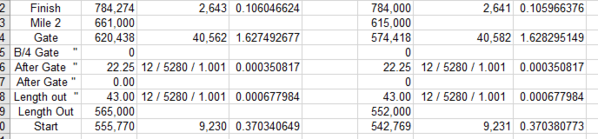
This will likely need to be an LDE application from your regional certifier and that's the best person to ask how they would like the measurement data submitted to them. Also with the grass being less than 10% of the total course distance it is acceptable to measure with your bike & jones counter on grass. There is no genuine need to pull that with steel tape unless you just want to.
Respectfully,
Brandon Wilson
Regional Certifier South Carolina
World Athletics A measurer
All grass sections of a course must be measured by steel tape, regardless of how long they are. See page 37 of the Procedures Manual.
Mark thank you for pointing that out, I do not ever recall seeing that before! I was hung up on the "For courses made up of paved and unpaved surfaces, Any surface that exceeds 10% of the total must be measured using a calibration on that or a similar surface." and didn't see "it is not permissible to measure grass sections with a calibrated bicycle"
The element of our occasional discussion about measuring unpaved sections of courses that tends to vex me is the anecdotal evidence that measuring on grass with a cal constant derived from a certified cal course on pavement tends to have a lengthening effect on the off-pavement part. That is, for instance, a 300 meter section measured on grass - as compared to a 300 meter paved section, - both using the same cal constant, tends to require fewer counts than on pavement, as verified by a subsequent steel tape check. It seems to me that there may be sufficient reason to investigate further. If measuring on grass reliably lengthens a course measurement and never shortens it, so to speak, might this auger well for off-road certifications?
I've read over page 37 a few times. My understanding is grass must always be steel taped. I also note the recommended procedure, to avoid errors, is using a calibrated bicycle for the entire course. For previous courses with a shorter distance of grass I have handled this in the notes. I note the start and finish counts across the grass then convert the counts to distance. I then tape the grass. There has always been slippage across the grass, making the course a little longer and proving it isn't shorter, but for simplicity I ride the entire course from start to finish.
So if there is no form... Just follow the example on page 53 of the manual?
Desired course length, 21120 feet. Measured course length 19920 feet. Use a steel tape to add 1200 feet.
Because it is steel tape, I don't think it needs to be steel taped twice but gross error check it with the bicycle and explain in the notes.
You planned procedure sounds good to me, but like Brandon said, I would run it by your certifier ahead of time to make sure he's good with it.
Thanks everyone for the feedback. I will send my certifier a note, because it would be best if he is onboard with my procedure before it shows up in his inbox.
The manual talks about 3 different types of surfaces: paved surface, unpaved surface, and unpaved surface that deforms significantly under the bicycle tire.
The first two are treated the same. If either make up more than 10% of the course, then you need to calibrate on a similar surface to measure that section.
The third type is more problematic because the calibration constant is likely to vary a lot depending on how much the surface deforms under the tire. Calibrating on wet sand, and then measuring on dry sand is almost certainly going to result in huge errors. For grass (which also deforms under the tire) the the calibration constant is probably going to vary significantly depending on the thickness and the length of the grass.
Many people on the measurement forum have reported that calibrating on hard-packed dirt or cinders (unpaved surfaces that don't deform significantly) gives constants that are slightly smaller than calibrating on pavement. I don't think many have reported a similar consistent experience for grass.