Read-Only Historical Archive — Posting and registration are permanently closed.
Measured a marathon today and 3 good things happened:
1. We had a 56F degree day in NYC on Feb 3 - bright sun, no wind.
2. The 8-year-old cal course at the race site (Flushing Meadow Park, site of the 1964 World's Fair, or for those of you a bit too young to remember that, the NY State pavilion that the alien bug used as an escape vehicle in Men In Black) 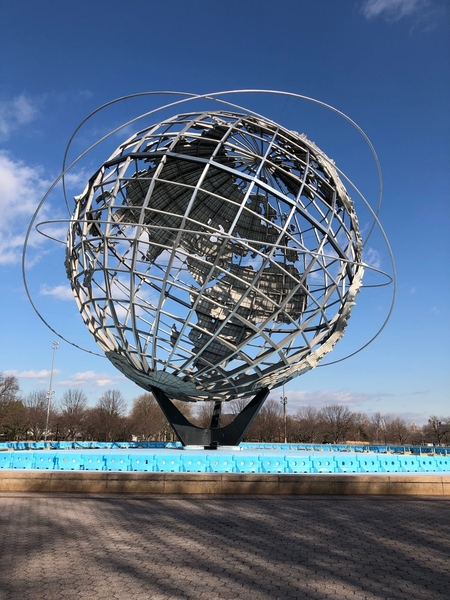
was still in existence - nails painted and all. (I'd calibrated at home before leaving just in case, but it was nice to do it right before and after the measurement)
3. The 1/4 marathon loop the organizers had mapped out came within 2 feet of the desired distance. How many times does that ever happen.
Oh yeah, I guess there was a fourth good thing. In spite of leaving Queens after 4 PM, I hit virtually no traffic on the ride home to CT - it was still light out when I got home.
There's a fifth thing. You got a great workout and burned a lot of calories. Win, win, win.
Well, a lot less than two rides of a full 26.2! And riding within sight of Citi Field reminded me that baseball season isn’t far away.
Do you charge full boat for "diet" marathon certifications? 
Sounds like a great day of measuring. I, on the other hand, had a Jones counter break at mile 4 while measuring a half marathon a couple of weeks ago. Here's to hoping I have more days like yours.
This has happened to me, Gary. I always carry a spare with me.
Your incident is one more reason to break your measurement into pieces using the SSS method. Bob Thurston uses SSS on virtually every measurement. I am gradually adopting his practice.
What is the "SSS" method? I know how to minimize losses but am curious about this.
"Sum of Shortest Segments". The concept here is to break the course into a few pieces, and keep the smallest number you get of at least two measurements of each particular section. The segments aren't at mile marks, and they are only very roughly equivalent in distance. For his marathon measurement, Jim may have broken up the full distance into as many as 8 pieces. All the shortest measurements are snapped together like Legos. The final piece gets the final adjustment to the nominal certified distance.
The purpose of this method is it can reduce errors in riding or in arithmetic, it can result in higher overall accuracy, and possibly most important for longer races in urban areas, this practice provides the potential to revise a course without having to ride the entire course. This technique is necessary for longer races in the D.C. area, where I measure most. Courses here tend to change with greater frequency than some places due to security concerns and construction projects.
If you have a flat tire while measuring say, the fourth of 4 sections in a half marathon, you still have most of the course measurement completed, and now you have to come back for just the final piece, not for another measurement of the full 13.10938.
For convenience, it is best to use some large fixed object to define your segment ends. Telephone poles and large light poles are good because they are often easy to spot.
Just curious how your numbers are turned in on that sort of measurement. I fully understand how notes and numbers would be tabulated, but how would you turn in those numbers on an application and make it clear what you did?
Good question, Ed. My understanding is that our online certification system will one day be equipped to accept this kind of measurement. For the present, you would simply list both or all measurements of each section on a sheet of paper or an Excel doc, highlighting the lowest number for each section. Then, you list each lowest measurement of each section in a column and add them up. The result should then be at least the total nominal distance of the race in question.
If the course comes out too long or too short, you must adjust at least one of the segments on the ends of the course or a turn around. You would show this on your work, too. Make sense?
It’s pretty straightforward (I hope). Since the loop is continuous I did 2 rides and compared them for the 0.0008% agreement, used the shorter one to establish the loop distance adjusted to make it 10,548.75m (1/4 marathon) and submitted that as both a marathon (loop run 4X) and half (2X). Same map for both just different page of split locations. The online system handles it via the non-standard course portal.