Here's a taping puzzle based on a recent check of a 1000 foot calibration course:
Tape was checked by NIST and found to have a length of 30.00948 m at 20C
Temperature while taping = 42F
Measurements:
10 lengths at 30 m = 300 m
partial length of 4.80815 m
What is the correct result of the single measurement?
Steel Taping Puzzle:
OK, here's what I got:
# Units # Units
Tape (NIST) 30.00948 meters at 20.00 C convert 68.00 F
Measured
Partial 4.80180 m
10 Full 300.00
Course Raw 304.80180 at 42.00 F
Divide 30 / NIST
NIST Corrected 304.70551 m
T dif F
Factor 1.00 plus 26.00 times 0.00000645 1.00016770
Corrected 304.7566122
Oscar
# Units # Units
Tape (NIST) 30.00948 meters at 20.00 C convert 68.00 F
Measured
Partial 4.80180 m
10 Full 300.00
Course Raw 304.80180 at 42.00 F
Divide 30 / NIST
NIST Corrected 304.70551 m
T dif F
Factor 1.00 plus 26.00 times 0.00000645 1.00016770
Corrected 304.7566122
Oscar
Dear Oscar,
We differ. Check your work and I will check mine.
Steel taping correction is the most error-prone part of our measurement process.
We differ. Check your work and I will check mine.
Steel taping correction is the most error-prone part of our measurement process.
How's this?
tape 30.948
10 tapes 309.48
extra 4.80815
total tapes 314.28815
temp 42
temp -68 -26
CF=1+0.00000645x(-26)
CF= 0.9998323
Corrected measurement
314.2354439
tape 30.948
10 tapes 309.48
extra 4.80815
total tapes 314.28815
temp 42
temp -68 -26
CF=1+0.00000645x(-26)
CF= 0.9998323
Corrected measurement
314.2354439
OK, I see. NIST/30 so raw measurement is actually longer.
Ooooopscar
Ooooopscar
Here's how I calculated it. It was nice to see how well my years-old 1000 feet checked out.
Bash me with commentary. I have sweated for hours on this blasted thing.
Raw Data
10 pulls at 30 m per pull = 300 m
Partial length = 4.80815 m (4 m plus 80.815 cm)
Total Raw Length 304.8082 m
The tape was checked by NIST and found to have a length of 30.00948 m at 20C (68F)
Because the true length is greater than the 30m indicated length, the tape marking error must be accounted for.
We must correct for both temperature and tape marking error
Calculations
Temperature Correction factor =(1+.00000645x(4268)) = 0.999832
Raw measurement corrected for temperature = 304.8082*.999832 =304.757 m
Because the tape was cold, the temperature corrected raw length is less than the total raw length.
Tape marking correction = 30.00948/30 = 1.000316
Total corrected course length = 304.757x1.000316 = 304.8533 m = 1000.175 feet
Oversize = 0.17499 feet
This is 1.7 parts in 10,000
This is within reasonable agreement for comparison with a single tape measurement
of 1000 feet obtained on a different day. The checked course is considered to pass validation check.
I get the same answer as Pete.
I haven't studied all the answers but Guido it's 30.00948 not 30.948, gotta respect those zero's.
I think it's simplest to first pretend that the tape is exactly 30 meters, do all the calculations, then multiply by the "Riegel tape factor" (30.00948/30 = 1.000316).
So, Raw measurement: 304.80815
Temp correction factor 68-42=26 degrees x 0.00000645=0.000168
304.80815 x 0.000168 = 0.051116.
(Subtract because it's cold, the tape contracts) 304.80815 - 0.051116 = 304.757034.
Now multiply by the Riegel tape correction factor:
304.757034 x 1.000316 = 304.853337
(which I would round to 304.853, about as close as you can read a tape-- ok if you like, take another digit, then 304.8533)
Looking at it now I think my steps are essentially the same as Pete's-- I just like to get the temperature correction amount, then wrestle with the question of whether to add or subtract.
Thanks for the challenge, Pete! But can you tell how you got 4.80815 (that's down to a hundredth of a millimeter, did you carry a machinist's vernier out there?)
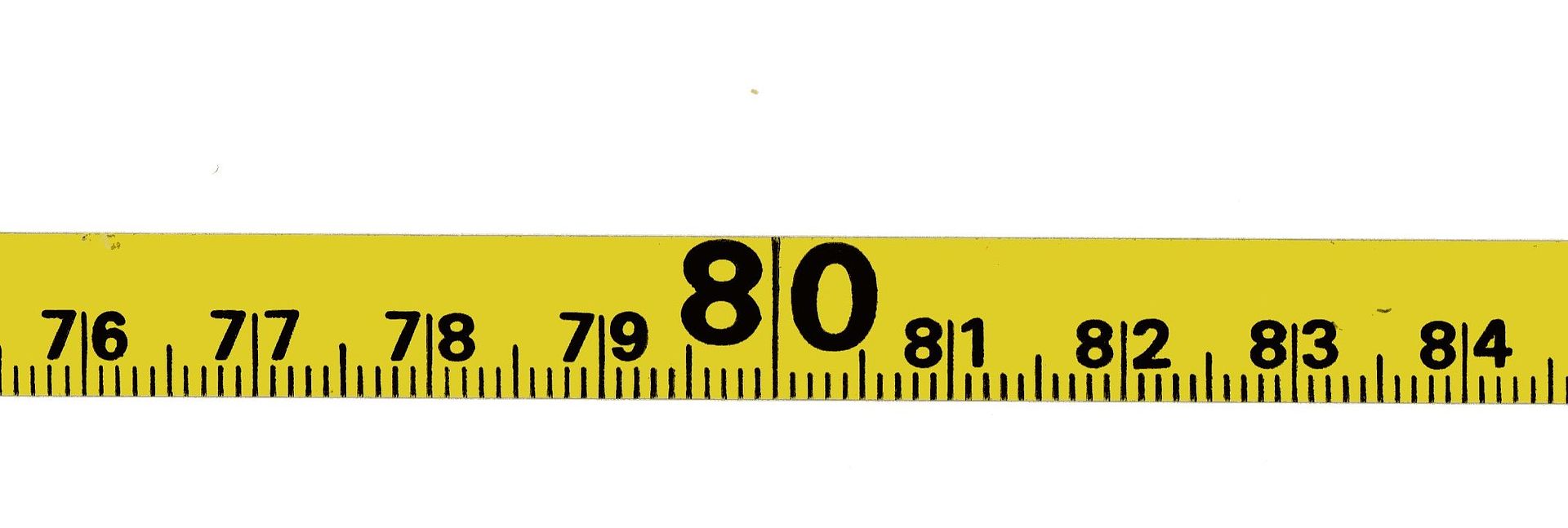
Here’s a shot of my tape at the 80 cm mark of the 4 meter length. Could be I made a mistake reading, could be I didn’t.
Thanks for checking. Stupid zeros!
Pete, I can see the marks for 80.8 cm and 80.9 and I think you could reasonably interpolate to get one more decimal place-- but I don't see how you could pick out 80.815 cm (i.e. 0.80815 m). Or maybe you look at 1/5ths of a millimeter, and if it's just under one fifth then estimate is 0.15?
I'm open to a new way of looking at it, I'm just curious about it.
I'm open to a new way of looking at it, I'm just curious about it.
Bob,
I am also puzzled. I think I have the correct computation for length if we accept 4.80815 as correct, but I obviously couldn't read the scale that closely. Of the likely correct possible readings I see 81.5 as a possible. The difference is about 7 mm, which still leaves the agreement with the original layout at less than 1/5000.
I have always had a bad time reading metric tapes. A foot is user-friendly - you can see the whole thing while taping. A whole meter, however, is less easy to visualize as a whole.
Looks like a flawed puzzle (rather a flawed puzzle-master) to me.
I've noticed that a lot depends on the way the tape is marked and laid out. My metric tape has a "reminder" printed at every 10 cm, telling you what meter you're working in. But I have to warn folks I'm measuring with that not every place that says "14 m" is the 14 m mark, you have to find the FIRST place where it says 14 and not 13.
With a metric tape I pick the nearest mm, so I record 3 digits after decimal point. With a tape in feet, I find a surveyor's tape marked in tenths of a foot is really handy. You can read the marks to hundredths of a foot, then interpolate to nearest thousandth.
To me the most elusive part about measuring with a steel tape is getting a good temperature reading-- a few degrees difference in temperature can make a surprising amount of difference in length, and in some conditions it's pretty hard to know what temperature to use. I suppose the best is when temps stay pretty steady with no sun shining on the tape.
A few days ago we measured a cal course in Newport News. I almost jumped for joy when we finished, and the recorded temperature throughout was 68 degrees F. Hooray, none of those treacherous temp adjustment calculations!!