Read-Only Historical Archive — Posting and registration are permanently closed.
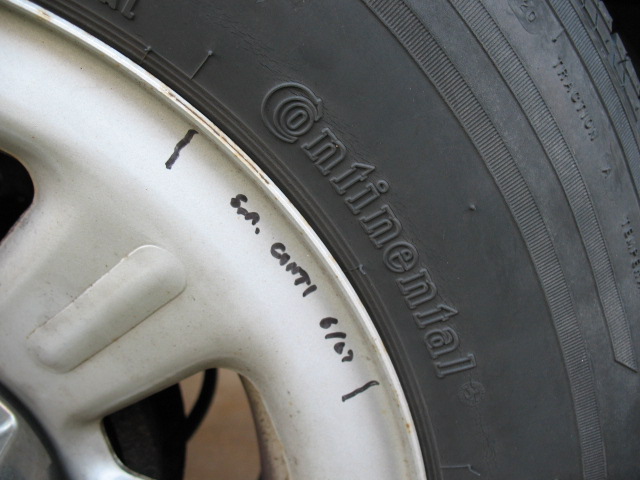
Three weeks ago, I had the wheels balanced on my truck. At that time, I marked the location of the tire relative to the rim, so I could measure "creep", or how much the tire moves on the rim. Creep is one reason that wheels require periodic re-balancing.
In three weeks and ~600 miles of driving, the tire has moved almost 1/4 inch forward. This is a shot of the right-rear wheel, so you can see the effect of tire creep.
One must assume that bicycle tires do the same. However, I'm sure it's well within the margin of error. I only mention it for academic purposes.
I noticed the same thing back when I was using solid tires. If too much creep happened in a tire with an inner tube it could damage the valve stem or tear it loose. I haven't heard of this happening.
What I find odd is that the unpowered front tires exhibit much less creep, and in the opposite direction. I'd expect more creep in the front due to greater loading and more hysteresis due to steering loads.
Here's another interesting tire fact for you. What is the effective radius of a slightly flattened tire. That is, what radius should you use when you calculate the distance covered by one revolution? Is it the flattened tire radius (center of rim to ground) or the unflattend tire radius?
Answer: Most people, including me, would assume it is the flattened tire radius, but it is actually much closer to the unflattened tire radius.
Here is how my Greentyre solid tire behaved for the first few hundred km after mounting.

This appeared in
Measurement News #81, January 1997. I have all 133 issues of Measurement News on a CD in pdf format, with an index.
Anybody wanting this CD, send me $3.00